Browse ships by class
Choose a class below, then open a hull for all three levels. Building costs and exploration details are on each hull’s page.
Fighters
 Fighters
Browse fighters · 8 hulls. Combat tables are on the class page; each hull has its own I–III comparison.
Corvettes
 Corvettes
Browse corvettes · 8 hulls. Combat tables are on the class page; each hull has its own I–III comparison.
Destroyers
 Destroyers
Browse destroyers · 8 hulls. Combat tables are on the class page; each hull has its own I–III comparison.
The fleet grid
A fleet is arranged in a 3 × 3 grid, with row 1 facing the enemy. Each occupied slot fires separately at a single enemy slot, and every ship in that slot fires at the same target.
Target selection depends on columns and the nearest live enemy rows. See the targeting rules.
Developer source: Combat Guide, §2, page 1.
How many ships count
A captain sets a cap on the ships contributing to each slot’s firepower, mitigation and interception:
| Hull class | Base cap per slot | Effective cap |
|---|---|---|
| Fighter | 1,100 | 1,100 + captain bonus |
| Corvette | 1,000 | 1,000 + captain bonus |
| Destroyer | 900 | 900 + captain bonus |
The captain bonus depends on rarity and stars. The paper describes an ordinary captain as adding nothing and a top-rarity captain at seven stars as adding about 1,000. It does not provide a complete rarity-by-star table. Recorded command capacities now cover all rarity-and-star combinations; use those displayed totals directly.
Ships above the cap still add structure and shields, but no further firepower, mitigation or interception. The paper also applies the cap to mitigation and interception; avoid equating a larger stack with proportionally greater combat output.
Developer source: Combat Guide, §4, page 2.
Movement and range
Movement per round uses the slowest ship in the fleet, capped at 16 cells, then adds captain bonuses. A mixed fleet can therefore have its movement constrained by its slowest hull.
Range is measured in grid cells using horizontal plus vertical distance. A fleet’s range is the union of its weapon ranges, with research adding range in whole cells. “Ship speed” is the hull’s Movement stat. Captain Velocity determines who acts first; Movement does not.
Developer source: Combat Guide, §1, page 1.
Developer clarification: Toxic, follow-up answers in the Combat Guide thread, supplied by KingFluffy on 11 October 2026. Read all clarifications.
Rows and flanking
| Situation | Damage modifier | Other effect |
|---|---|---|
| Hit the enemy from behind | +10% | Target loses stability for that volley |
| Hit the enemy from a side | +20% | — |
| Fire from your own second row | −10% | — |
| Fire from your own third row | −25% | — |
A fleet turns towards its chosen target before it fires. The paper explains flanking as firing before the opponent has turned. A rear attack also reduces the stability bonus by 0.5 for that attack; see Steadiness.
Developer source: Combat Guide, §7; rear stability detail in §10 on page 5, page 4.
Hull stats in combat
| Stat | Documented role |
|---|---|
| Maneuverability | Reduces incoming hit rate; hull values range from 0.1 to 10 before research. |
| Icarus | Reduces incoming damage with diminishing returns; hull values range from 0.8 to 11.6 before bonuses and research. |
| Steadiness | Helps determine ships lost to a single attack; hull values range from 1.0 to 1.7. |
| Shields and hull | Shared pools per slot, calculated from per-ship value × ship count. |
See hit rate and defence mechanics. Individual hull names, equipment slots, costs and upgrade tables are not supplied by the paper.
Developer source: Combat Guide, §5; §7 on page 4 and §§8–10 on pages 4–5, page 2.
Ship production & dismantling
The GigaFactory Station produces ships; the supplied level 19 overview shows four production slots and a 35% Ship Production Bonus Percent. It is below maximum level. The Deconstructor is shown at maximum level 10, with 35% Ship Scrap Recovery Percent.
Source: supplied building screenshots and wiki owner confirmation, 1 October 2026.
Equipment and hull space
Module Usage is the amount of space it occupies on a hull. See Defense modules, engines and shields for Usage, combat stats and building costs at each supplied level.
Hull sheets and source differences
The fuller level sheets supply the current tables above. Destroyer III values differ from the earlier summary; no patch date or explanation was supplied. Both sources are retained for comparison.
| Destroyer | Earlier III: storage / shield / armor | Fuller sheet III: storage / shield / armor |
|---|---|---|
| Awaiting ImageSubmit imageAstraea | 270 / 270 / 1370 | 300 / 180 / 1730 |
 Achlys | 310 / 330 / 1680 | 330 / 220 / 2110 |
 Bane | 340 / 390 / 1990 | 380 / 250 / 2500 |
 Vespucci | 380 / 450 / 2300 | 410 / 300 / 2900 |
 Vindicator | 420 / 550 / 2770 | 450 / 370 / 3530 |
 Fellcore | 460 / 640 / 3360 | 490 / 440 / 4280 |
 Minotrax | 500 / 780 / 4050 | 530 / 540 / 5170 |
 Chronovex | 540 / 940 / 4880 | 570 / 660 / 6240 |
Reckless is the in-game spelling confirmed by KingFluffy. Felicore is linked to Fellcore. The starter Corvette appears as Achelous in the fuller sheet and was previously recorded as Achelous. Stable blueprint links are retained.
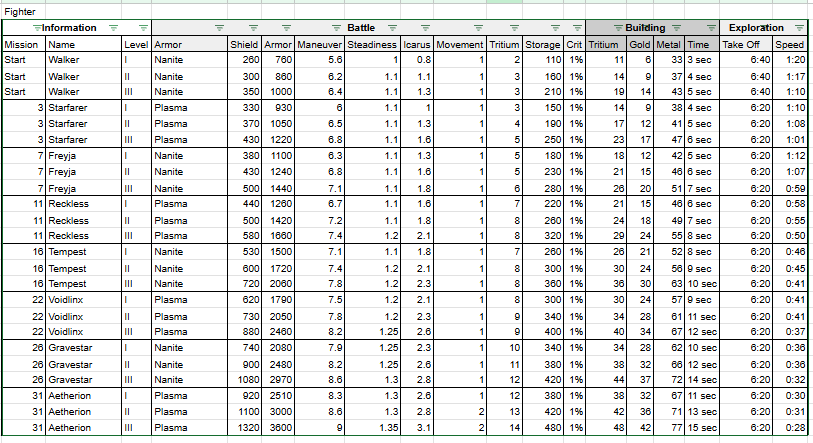
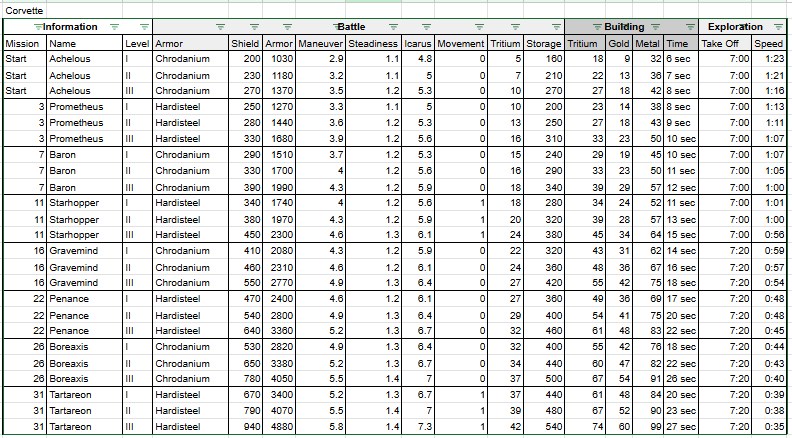
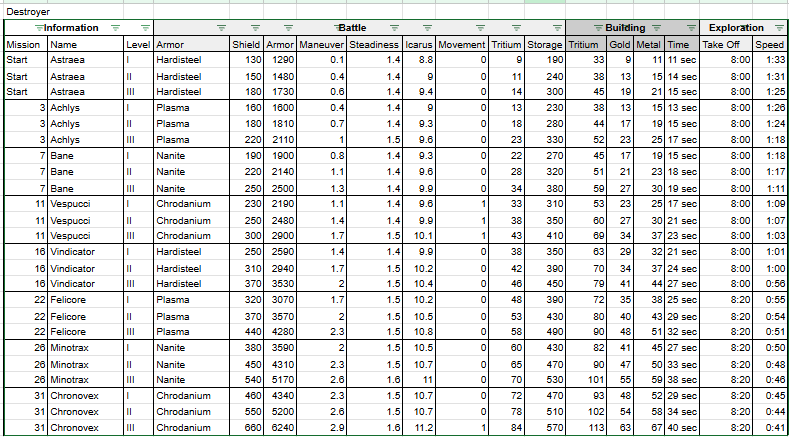
Earlier summary sheet · Supplied by the wiki owner, 1 October 2026. Portraits, descriptions and blueprint upgrade requirements still need equipment screenshots.
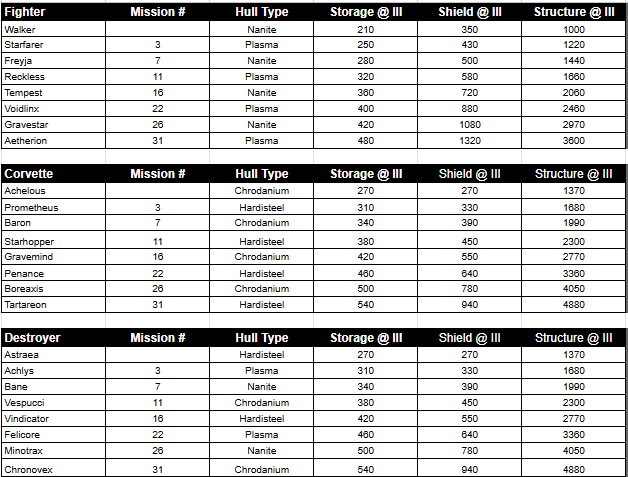
Hull material damage matchups
A hull’s material / Hull Type determines its damage matchups. The developer chart uses the word “armor” for these four materials. Fighter, Corvette and Destroyer are separate hull classes.
| Hull material / armor | Thermic | Blast | Electro | Flechette |
|---|---|---|---|---|
| Chrodanium | 50% | 150% | 100% | 75% |
| Nanite | 75% | 50% | 150% | 100% |
| Plasma | 100% | 75% | 50% | 150% |
| Hardisteel | 150% | 100% | 75% | 50% |
150% = amplified (1.5×); 100% = full damage (1×); 75% = reduced (0.75×); 50% = heavily resisted (0.5×).
Damage types to bring against each hull material
| Target hull material | Strongest damage type | Damage | Most resisted damage type | Damage |
|---|---|---|---|---|
| Chrodanium | Blast | 150% | Thermic | 50% |
| Nanite | Electro | 150% | Blast | 50% |
| Plasma | Flechette | 150% | Electro | 50% |
| Hardisteel | Thermic | 150% | Flechette | 50% |
Match the material in the hull stat tables below to the target row above. See weapon damage matchups for the original chart and Combat for other effects on final damage.
Source: developer chart supplied by the wiki owner, 1 October 2026; consistent with the September 2026 developer combat paper.